
Introduction
Metal lock washers are mechanical fasteners used to prevent loosening of bolted joints due to vibration and torque fluctuations. Positioned under the nut or bolt head, they provide a secondary locking force through friction, indentation, or a combination of both. Unlike self-locking nuts which rely on nylon inserts or deformed threads, lock washers offer a simpler, often more robust solution suitable for a wide range of industrial applications. Within the fastening industry chain, they represent a critical component ensuring joint integrity and long-term performance in sectors including automotive, aerospace, construction, and heavy machinery. Core performance characteristics revolve around maintaining preload, resisting loosening under dynamic loads, and providing consistent locking force across varying temperatures and environments. The selection of appropriate lock washer type directly impacts the reliability and safety of assembled structures.
Material Science & Manufacturing
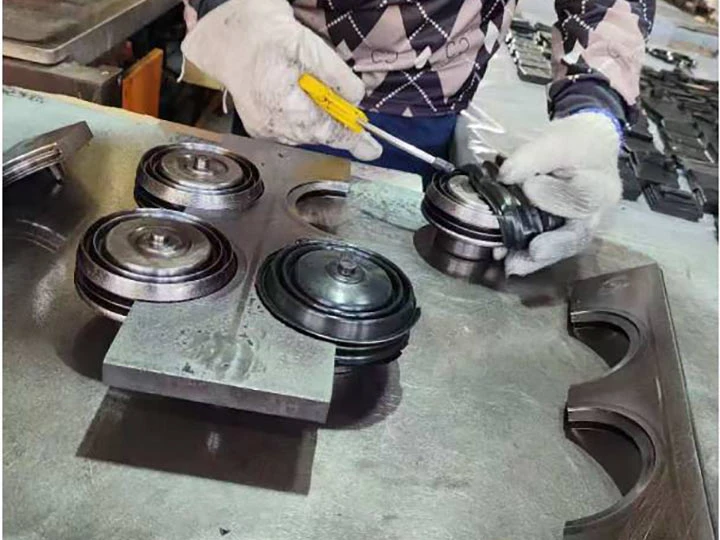
Metal lock washers are commonly manufactured from medium to high carbon spring steels (ASTM A685 Type 1, EN 10270-1), stainless steels (304, 316 - ASTM A313), and occasionally alloy steels, depending on the application’s corrosion resistance and strength requirements. Spring steel’s high yield strength and elasticity enable it to generate significant locking force. Stainless steel offers excellent corrosion resistance, critical for outdoor or chemically aggressive environments. The manufacturing process typically begins with wire drawing to achieve the desired diameter. Cold forming, often through a progressive die stamping process, shapes the wire into the lock washer’s specific configuration - split, tooth, wave, or conical spring. Key parameters during stamping include die alignment, stroke length, and material feed rate; deviations can cause dimensional inaccuracies and reduced spring force. Heat treatment, including hardening and tempering, is crucial to achieving the desired spring characteristics (hardness, tensile strength, and ductility). Surface treatments like zinc plating (ASTM B633), phosphate coating (MIL-STD-868), or passivation (ASTM A967) provide additional corrosion protection. Quality control checks include dimensional inspection (using calipers, micrometers, and optical comparators), hardness testing (Rockwell or Vickers scales), and spring force measurement to ensure conformity to specifications. Material composition is verified via spectroscopic analysis.
Performance & Engineering
The performance of a lock washer is primarily assessed through its ability to maintain clamp load in a bolted joint subjected to dynamic loading. Force analysis involves calculating the initial preload applied to the bolt and the reduction in preload due to vibration, relaxation, and thermal cycling. Lock washers counteract preload loss by providing a restoring force. Split lock washers function by increasing the frictional force between the nut/bolt and the clamped surfaces; however, their effectiveness decreases with repeated vibrations. Tooth lock washers dig into the mating surfaces, providing a more positive locking action. Wave washers are used for lightweight applications and provide consistent locking force. Environmental resistance is vital; corrosion can significantly reduce lock washer performance and lead to joint failure. Stainless steel grades offer superior resistance to chloride-induced pitting and crevice corrosion. Compliance requirements depend on the application; for example, aerospace applications adhere to stringent specifications like NASM 25027. Finite element analysis (FEA) is often employed to optimize lock washer geometry and predict its performance under various loading conditions, ensuring adequate fatigue life and preventing stress concentrations that could lead to premature failure. The material's Poisson's ratio, shear modulus, and yield strength are critical inputs for these simulations.
Technical Specifications
| Material Grade | Tensile Strength (MPa) | Hardness (HRC) | Typical Application |
|---|---|---|---|
| Spring Steel (ASTM A685 Type 1) | 896 - 1100 | 40-45 | General industrial, automotive |
| Stainless Steel 304 | 517 - 724 | 25-30 | Corrosive environments, food processing |
| Stainless Steel 316 | 586 - 862 | 28-32 | Marine applications, chemical processing |
| Alloy Steel (4140) | 655 - 827 | 30-35 | High-stress applications, heavy machinery |
| Zinc Plated Spring Steel | 896 - 1100 (base steel) | 40-45 | Improved corrosion resistance, general purpose |
| Phosphate Coated Spring Steel | 896 - 1100 (base steel) | 40-45 | Provides lubrication and corrosion protection |
Failure Mode & Maintenance
Metal lock washers are susceptible to several failure modes. Fatigue cracking can occur under cyclic loading, particularly at stress concentration points around the split or teeth. Corrosion, especially in chloride-rich environments, can lead to pitting and weakening of the material. Over-compression, resulting from excessive tightening, can permanently deform the washer and reduce its spring force. Hydrogen embrittlement, a concern with high-strength steels in corrosive environments, can reduce ductility and promote brittle fracture. Delamination can occur in coated washers due to poor adhesion of the coating. Maintenance primarily involves visual inspection for signs of corrosion, deformation, or cracking. Regularly check bolt torque to ensure adequate preload. Replace washers showing any evidence of damage. In critical applications, consider implementing a preventative maintenance schedule with periodic torque checks and washer replacement. Using appropriate lubrication can help prevent galling and corrosion. For applications involving extreme temperatures, select materials with appropriate thermal expansion coefficients to minimize preload loss. Careful selection of coating type is crucial for enhancing corrosion resistance based on the specific operating environment.
Industry FAQ
Q: What is the difference between a split lock washer and a tooth lock washer in terms of locking performance?
A: Split lock washers rely on friction to resist loosening, increasing the force needed to rotate the nut. However, their performance diminishes with repeated vibration. Tooth lock washers bite into the mating surfaces, creating a positive mechanical lock that is more resistant to loosening, especially under high-vibration conditions. Tooth washers generally provide a more reliable locking mechanism, though they can damage softer materials.
Q: Can I reuse a lock washer?
A: Generally, it is not recommended to reuse a lock washer. Each time a washer is compressed, it loses some of its spring force. Reusing a washer can compromise the joint's integrity. Split lock washers can flatten with use, significantly reducing their effectiveness. Tooth washers can have their teeth blunted, diminishing their locking ability. Replacement is the best practice to ensure reliable performance.
Q: What material is best for a lock washer in a marine environment?
A: Stainless Steel 316 is the most suitable material for lock washers in marine environments due to its superior corrosion resistance to chlorides. 304 stainless steel offers good corrosion resistance, but 316 is significantly more resistant to pitting and crevice corrosion in saltwater. Proper passivation treatment is also essential for maximizing corrosion protection.
Q: How does temperature affect the performance of a lock washer?
A: Temperature fluctuations can impact the preload in a bolted joint. Thermal expansion and contraction of the bolt, nut, and clamped materials can cause preload loss or gain. Lock washers can help mitigate this by maintaining a consistent spring force. However, extreme temperatures can also affect the material properties of the washer itself, potentially reducing its strength or elasticity. Material selection should consider the operating temperature range.
Q: Are there any standards for the testing of lock washer performance?
A: Yes, several standards address the testing of lock washer performance. ASTM F312 outlines methods for determining the performance characteristics of locking devices, including lock washers. SAE J2417 covers testing procedures for vibration resistance of fasteners, including those utilizing lock washers. Industry-specific standards, such as those from aerospace (NASM) or automotive (IATF 16949), may also apply.
Conclusion
Metal lock washers are critical components in ensuring the reliability of bolted joints across a diverse range of industries. Their effectiveness stems from a careful balance of material properties, manufacturing precision, and engineering design, allowing them to mitigate loosening due to vibration and dynamic loads. Understanding the different types of lock washers, their respective performance characteristics, and potential failure modes is essential for proper selection and application.
Future advancements in lock washer technology may focus on developing materials with enhanced fatigue resistance and corrosion protection, as well as innovative designs that provide even greater locking force and adaptability to varying operating conditions. Continued adherence to industry standards and rigorous testing protocols will remain vital in ensuring the ongoing safety and performance of these ubiquitous fasteners.